Saturday, May 17, 2014

Review 11.2 Vectors in space


Basic Information: Component form: v = <v1, v2, v3> Unit vector form: v = v1i + v2j + v3k Standard unit vector notation uses these unit vectors: i = <1, 0, 0>, j = <0, 1, 0> and k = <0, 0, 1>. Zero vector: 0 = <0, 0, 0>
Vectors in Space: 1. Two vectors are equal if and only if their corresponding components are equal. 2. The length of vector u = <u1, u2, u3> is: ||u|| = √(u1 3. A unit vector u in the direction of v is given by: u = v / ||v||, v ≠ 0 4. The sum of u = <u1, u2, u3> and v = <v1, v2, v3> is: u + v = <u1 + v1, u2 + v2, u3 + v3> 5. The scalar multiple of the real number c and vector u is: cu = <cu1, cu2, cu3> 6. The dot product of vector u and vector v is: u • v = u1v1 + u2v2 + u3v3
Angle Between Two Nonzero Vectors If θ is the angle between two nonzero vectors u and v, then: cosθ = (u • v) / (||u|| ||v||) If the dot product of two nonzero vectors is 0, the vectors are orthogonal (perpendicular). In general, two nonzero vectors u and v are parallel if there is some scalar c such that u = cv.
Using Vectors to Determine Collinear Points The points P, Q, and R are collinear if and only if the vectors PQ and PR are parallel.

Example #1:
Find the dot product of the vectors: u = <5, 8, 2> and v = <7, 1, 6>.
u • v = (5)(7) + (8)(1) + (2)(6) = 35 + 8 + 12 = 55

Tuesday, May 13, 2014

Review 5.2 Verifying Trigonometric Identities


In 5.2, the purpose is to verify trigonometric identities. In order to verify trigonometric identities, fundamental identities and the rules of algebra are important to be memorized. There are 4 

rules for verifying trigonometric identities:
1. Work with only one side the equation.
2. Factor an expression, add fractions, square binomials, or create a monomaniacal denominator.
3. Look for opportunities to use the fundamental identities .
4. Convert all terms to sines and cosines if the preceding guidelines do not help.


Example#1: 
2sec^2x - 2sec^2xsin^2x - sin^2x - cos^2x
=2sec^2x (1-sin^2x)-sin^2x-cos^2x Factor
=2sec^2x(cos^2x)-sin^x-cos^2x Pythagorean identities
=2(1/cos^2x)(cos^2x)-sin^x-cos^2x Reciprocal identities
=2-sin^2x-(1-sin^2x) Pythagorean identities
=2-sin^2x-1+sin^x Simplify

Review 5.3 Solving Trigonometric Equations


Summary:
• To solve a trigonometric equation by using standard algebraic techniques.
• Solving trigonometric equations of quadratic type.
• Solving trigonometric equations involving multiple angles.
• Use inverse function to solve the trigonometric equations.


Rules for solving trigonometric equation:
• Algebra rule (factor, simplify, combine terms).
• Constantly be aware of to the interval for each problem.
• For inverse functions, try to use several different identities to work out the problem.
• Do not forget to add 2nπ for general solution of sine and cosine; add n π for general solution of tangent.


Example 1: Solve 2sin²x+3cosx-3=0
Try to rewriting the equation so that it has only cosine functions.
2sin²x+3cosx-3=0
2(1-cos²x)+3cosx-3=0 Pythagorean identity
Setting each factor equal to zero, to get the general solution:
2cos²x-3cosx+1=0 Multiply both sides by-1
(2cosx-1)(cos x-1)=0 Factor
cos x=1/2 and cos x=1
x=2nπ,x=π/3+2nπ,x=5π/3+2nπ


Friday, May 9, 2014

MATH GAME

This game is centuries old, Captain James Cook used to play it with his fellow officers on his long voyages, and so it has also been called "Captain's Mistress". Milton Bradley (now owned by Hasbro) published a version of this game called "Connect Four" in 1974.
Other names for this this game are "Four-in-a-Row" and "Plot Four".
http://www.mathsisfun.com/games/connect4.html
here is the link for the game. have fun guys

Wednesday, May 7, 2014

12.4 Limits at Infinity and Limits of Sequences


Example:

The numerator is always 100 and the denominator tex2html_wrap_inline294 approaches tex2html_wrap_inline296 as x approaches tex2html_wrap_inline296 , so that the resulting fraction approaches 0.


12.5 The area Problem

In order calculate the area of region, we need know the following summation formulas and properties, which are used to evaluate finite and infinite summations. 


Thursday, May 1, 2014

finding math talents

Sara, who is 5 years old, listens as her 32-year-old father comments that today is her grandmother's 64th birthday. "Grandma's age is just twice my age," he observes.
Although outwardly Sara does not seem to react to this information, her mind is whirling. A few moments pass, and then the young girl excitedly replies, "You know Dad, you will only be 54 when your age is twice mine!"
Sara has been intrigued by numbers and numerical relationships since she was very small. At first this could be seen in the way she liked to count things and organize groups of objects. She showed a fascination for calendars, telephone numbers, dates, ages, measurements, and almost anything else dealing with numbers. Sara learned and remembered this information quickly and easily, but what was even more amazing was the way she played with and manipulated the information she was learning. She would carefully examine each idea and eagerly search to discover new, interesting, and unusual relationships and patterns. Although Sara has had little formal instruction in mathematics, at the age of 5 she has acquired an incredible amount of mathematical knowledge and is amazingly sophisticated in using this knowledge to discover new ideas and solve problems.
Sara is an example of a young child who is highly talented in the area of mathematics. Like most individuals with this unusual talent, Sara exhibits characteristics and behaviors that are clues to her ability. Some mathematically talented people radiate many or obvious clues, others offer only a few, or subtle ones. Recognizing these clues is often an important first step in discovering an individual's high ability in mathematics. It is difficult to believe, but many people with a high degree of mathematical talent have their talent underestimated or even unrecognized. Their clues have gone unnoticed or ignored, and the true nature of their ability remains unexplored. If Sara's talent in mathematics is to be discovered and appropriately nurtured, it is important that her parents and teachers recognize the clues.
  
Information fromhttp://www.gifted.uconn.edu/siegle/tag/Digests/e482.html

Wednesday, April 30, 2014

Intoduction of Limits

   Definition of Limits: 

  • If f(x) becomes arbitrarily close to a unique numeb L as x approaches c from either side, the limit of f(x) as a approaches c is L. 
   Conditions under which Limits do not exist:

  • f(x) approaches a different number from the right side of c than from the left side of c
  • f(x) incereses or decreases without bound as x approaches c
  • f(x) oscillates between tweo fixed values as x approaches c


Techniques for Evaluating Limits


Example of substitution:


Example of factor:


Example of conjugate:


Thursday, April 10, 2014

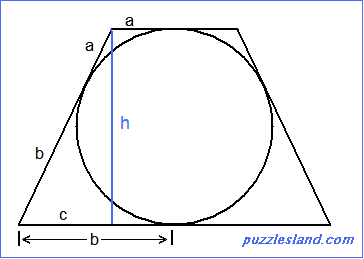
Heights of isosceles trapeziod

Given the bases, A and B, of an isosceles trapezoid,
determine the legs and the height, h. 

Let A = 2a and B = 2b.

If we draw the inscribed circle,
and note that tangents to a circle from a common point are equal,
we see that the legs of the trapezoid
are equal to (a + b) = (A + B) / 2.

If we drop the perpendicular shown in blue, we have c = b - a.

From the Pythagorean Theorem:
(b - a)^2 + h^2 = (b + a)^2
b^2 - 2ab + a^2 + h^2 = b^2 + 2ab + a^2
h^2 = 4ab and h = 2 sqrt(ab)

Tuesday, April 8, 2014

11.2 Vectors in Space

 Vectors in space can described by ordered triples of coordinates (x,y,z). Geometrically, the vector can be thought of as an arrow pointing from the origin to this point in space.


11.1 The Three-Dimensional Coordinate System

The 3-D coordinate system is formed by passing a z-axis perpendicular to both the x-axis and y-axis at the origin.


x = directed distance from yz-plane to P
y = directed distance frim xz-plane to P
z = directed distance from xy-plane to P


Example: Find the distance between (1, 0, 2) and (2, 4,-3)


5 graph


Thursday, March 27, 2014

10.7 Graphs of Polar Equations


  • Polar Equations in Parametric form: x=f(t)cost  and  y=f(t)sint
  • Test for Symmetry in Polar Coordinates
              The graph of a polar equation is symmetric with respect to the following if the given substitution yields an equivalent equation.
              1 The line θ=π/2: Replace (r, θ) by (-r, θ)
              2 The polar axis: Replace (r,θ) by (r,-θ)
              3 The Pole (origin): Replace (r,θ) by (-r,θ)


Different types of polar graphs


Interest problem

As a percent (per year) of the amount borrowed is called interest. 

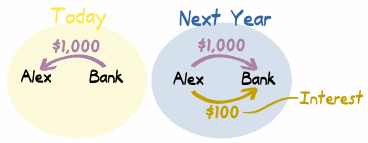
 Borrow $1,000 from the Bank

Alex wants to borrow $1,000. The local bank says "10% Interest". So to borrow the $1,000 for 1 year will cost:
$1,000 × 10% = $100
In this case the "Interest" is $100, and the "Interest Rate" is 10% (but people often say "10% Interest" without saying "Rate")
Of course, Alex will have to pay back the original $1,000 after one year, so this is what happens:
Alex Borrows $1,000, but has to pay back $1,100

This is the idea of Interest ... paying for the use of the money.

There are special words used when borrowing money, as shown here:
Alex is the Borrower, the Bank is the Lender. The Principal of the Loan is $1,000. 
The Interest is $100

Monday, March 24, 2014

10.6 Polar Coordinates

In order to form the polar coordinate system in the plane, we need point O, called the polr or origin, and construct from O an initial ray called the polar axis. Then each point P in the plane can be assigned polar coordinates (r, θ).
1 r = directed distance from O to P
θ = directed angle, counterclockwise from polar axis to segment OP. 


Thursday, March 20, 2014

Funny math jokes

Math jokes have an elemental role in the history of the internet. From the earliest Usenet threads to the techiest subreddits, geeky math jokes — some implicit swipes at less-pure disciplines, other puns or plays on words of different concepts — have been a major part of the modern history of math. What's more, these japes also have the effect of making those who didn't get the joke to look into what makes it funny, teaching people some of the more obscure concepts. Here are just a few of the best ones. Where necessary, we'll do the unthinkable and the tacky and explain the joke. 
1. Three statisticians go out hunting together. After a while they spot a solitary rabbit. The first statistician takes aim and overshoots. The second aims and undershoots. The third shouts out "We got him!"
2. There was a statistician that drowned crossing a river... It was 3 feet deep on average. 

Wednesday, March 19, 2014

10.4 Rotation and Systems


3 important steps to solve the problem:
1. Find the angle using the formula cot 2θ=A-C/B, using unit circle. Remember to divide the number by 2.
2. New x and y. Use the formula x=x'cosθ-y'sinθ    y=x'sinθ+y'cosθ
3. Substitute the x and y back to the equation.


Monday, March 17, 2014

10.3 Hyperbola

A hyperbola is the set of all points (x,y) difference of whose distances from 2 distinct points (foci) is constant.
To solve hyperbola, we need to know the center, vertices, foci, and asymptotes. Center is point h and k; vertices is the a value, which is a distant to the center; foci is c distant to the center, c^2=a^2+b^2. Different equation will have a different hyperbola, and it will also change the direction of the hyperbola. 


Thursday, March 13, 2014

10.2 Ellipses

Ellipse is a set of all points (x,y) the sum of whose distances from weo fixed points is constant.


Note: Major Axis should always be the long axis.


There is another equation, which is eccentricity, it means the ovalness of an ellipse.
When the problem ask us to find a standard equation by giving us a equation, we should simplify first, and then complete the square form, remember to add the right number to both sides.


Pi

A pair of Japanese and Us computer scientists currently holds the record for calculating the most digits of pi, they came up to five TRILLION decimal places. In 2010, Shigeru Kondo and Alexander Yee eclipsed the previous record of 2.7 trillion places. The pair used a desktop computer with 20 external hard disks that cost 18000 dollars and took them 90 days to make the calculation. 

Wednesday, March 12, 2014

10.1 Parabolas

A Parabola is a set of all points (x,y) that are equidistant from a fixed line (directrix), and a fixed point not on the line (facous).