Thursday, March 27, 2014

10.7 Graphs of Polar Equations


  • Polar Equations in Parametric form: x=f(t)cost  and  y=f(t)sint
  • Test for Symmetry in Polar Coordinates
              The graph of a polar equation is symmetric with respect to the following if the given substitution yields an equivalent equation.
              1 The line θ=π/2: Replace (r, θ) by (-r, θ)
              2 The polar axis: Replace (r,θ) by (r,-θ)
              3 The Pole (origin): Replace (r,θ) by (-r,θ)


Different types of polar graphs


Interest problem

As a percent (per year) of the amount borrowed is called interest. 

 Borrow $1,000 from the Bank

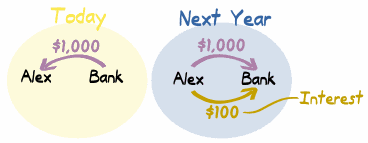
Alex wants to borrow $1,000. The local bank says "10% Interest". So to borrow the $1,000 for 1 year will cost:
$1,000 × 10% = $100
In this case the "Interest" is $100, and the "Interest Rate" is 10% (but people often say "10% Interest" without saying "Rate")
Of course, Alex will have to pay back the original $1,000 after one year, so this is what happens:
Alex Borrows $1,000, but has to pay back $1,100

This is the idea of Interest ... paying for the use of the money.

There are special words used when borrowing money, as shown here:
Alex is the Borrower, the Bank is the Lender. The Principal of the Loan is $1,000. 
The Interest is $100

Monday, March 24, 2014

10.6 Polar Coordinates

In order to form the polar coordinate system in the plane, we need point O, called the polr or origin, and construct from O an initial ray called the polar axis. Then each point P in the plane can be assigned polar coordinates (r, θ).
1 r = directed distance from O to P
θ = directed angle, counterclockwise from polar axis to segment OP. 


Thursday, March 20, 2014

Funny math jokes

Math jokes have an elemental role in the history of the internet. From the earliest Usenet threads to the techiest subreddits, geeky math jokes — some implicit swipes at less-pure disciplines, other puns or plays on words of different concepts — have been a major part of the modern history of math. What's more, these japes also have the effect of making those who didn't get the joke to look into what makes it funny, teaching people some of the more obscure concepts. Here are just a few of the best ones. Where necessary, we'll do the unthinkable and the tacky and explain the joke. 
1. Three statisticians go out hunting together. After a while they spot a solitary rabbit. The first statistician takes aim and overshoots. The second aims and undershoots. The third shouts out "We got him!"
2. There was a statistician that drowned crossing a river... It was 3 feet deep on average. 

Wednesday, March 19, 2014

10.4 Rotation and Systems


3 important steps to solve the problem:
1. Find the angle using the formula cot 2θ=A-C/B, using unit circle. Remember to divide the number by 2.
2. New x and y. Use the formula x=x'cosθ-y'sinθ    y=x'sinθ+y'cosθ
3. Substitute the x and y back to the equation.


Monday, March 17, 2014

10.3 Hyperbola

A hyperbola is the set of all points (x,y) difference of whose distances from 2 distinct points (foci) is constant.
To solve hyperbola, we need to know the center, vertices, foci, and asymptotes. Center is point h and k; vertices is the a value, which is a distant to the center; foci is c distant to the center, c^2=a^2+b^2. Different equation will have a different hyperbola, and it will also change the direction of the hyperbola. 


Thursday, March 13, 2014

10.2 Ellipses

Ellipse is a set of all points (x,y) the sum of whose distances from weo fixed points is constant.


Note: Major Axis should always be the long axis.


There is another equation, which is eccentricity, it means the ovalness of an ellipse.
When the problem ask us to find a standard equation by giving us a equation, we should simplify first, and then complete the square form, remember to add the right number to both sides.


Pi

A pair of Japanese and Us computer scientists currently holds the record for calculating the most digits of pi, they came up to five TRILLION decimal places. In 2010, Shigeru Kondo and Alexander Yee eclipsed the previous record of 2.7 trillion places. The pair used a desktop computer with 20 external hard disks that cost 18000 dollars and took them 90 days to make the calculation. 

Wednesday, March 12, 2014

10.1 Parabolas

A Parabola is a set of all points (x,y) that are equidistant from a fixed line (directrix), and a fixed point not on the line (facous).


Wednesday, March 5, 2014

Fractions

The first group of people who used fractions could be the Egyptians around 1600B.C. in the Rhind Papyrus, which contained the work of Egyptians mathematicians. They used a special kind of fractions to express ratio called unit fractions. Unit fractions are ratios of base being positive integers and numerator of 1. For example, 1/5 and 1/13.
They would then write 2/5 as 1/3+1/15. 
The image on the left showed how Egyptians use symbols to write fractions.

9.7 Probability

In general:
Probability of an event happening P(E) = Number of ways it can happen n(E)
Total number of outcomes n(S)

Example: The probability of rolling a " 6 "with a die.
               Number of ways it can happen: 1 (since there has only 1 face with a "6" on a die)
               Total number of outcomes: 6 ( because there has total 6 faces on a die)
               so we write probability =1/6


Also, we can know the probability from the probability line, and it is always between 0 and 1. When the probability is zero then it's consider an impossible event; for the probability of 1 we called certain event.


9.5 The Binomial Theorem

The Binomial Theorem is a quick way of expanding a binomial expression that has been reised to some power. In order to solve that problem, we need to use Pascal's Triangle. It is a convenient way to remember  a pattern for binomial coefficients. 


Example: What is (x+5)4

Start with exponents:x450x351x252x153x054
Include Coefficients:1x4504x3516x2524x1531x054
                    (x+5)4 = x4 + 20x3 + 150x2 + 500x + 625